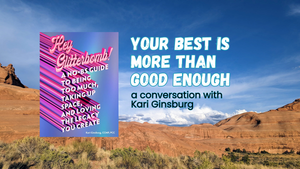
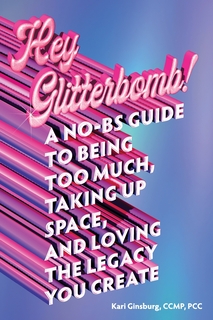
I am so excited to share my conversation with Kari Ginsburg, coach and author of Hey Glitterbomb! A No-BS Guide to Being Too Much, Taking Up Space, and Loving the Legacy You Create.
Reading Kari's book, I was impressed by the quality, practicality, and inclusiveness of her advice. Her caring process seems relevant to both personal and business goals. So I was delighted that she agreed to share more of her insights with us right here at Amplify Respect.
Kari was kind enough to offer us a special discount on her book. You can purchase Hey Glitterbomb! here.

And now, let's dive into our conversation!
(This interview has been condensed and lightly edited.)

Amplify Respect is a newsletter to uplift and inform trans folks and allies.
If you find it helpful to learn how to talk about a trans family member, how to promote your work as an LGBTQ+ creator, or how to write about trans people respectfully, you should subscribe.
Rey: Kari, I love your book. I started reading it and I’m processing and doing the exercises and taking my time with it. You have so much great information packed in. Who did you write this book for? Who should go out and buy it right now like I just did?
Kari: This book was published one month and one day after the five-year anniversary of launching my business. It feels like the culmination of five years of experience and honing my methodology.
My “methodology”—and I put that in quotes because I’m not a very rigid coach in my approach—is very casual and conversational. I really enjoy being in the discussion and the exploration with my clients. But there are certain things that I have found I come back to again and again and again, and that I have seen really resonate with people as they are reaching out and reaching up for something that is uniquely and dynamically their own.
And so I wrote this for anybody who has ever felt they are at the same time too much and not enough. Anybody who has been told they need to change who they are in order to be successful. Anybody who has been put in a box, when quite honestly, there’s never been a box to begin with.
The box is an effort to control or restrain things that the male, pale, stale, way of doing things has always found threatening to their way of success. If they don’t understand it, it can’t possibly be of value, importance, or forward-looking impact, right?
Rey: I really appreciate how you describe an experience that I think a lot of us have about being told you’re too much or not enough. And how to step outside the box—I feel like that’s a lot of what you coach and what your materials help people to do, which is amazing!
Kari: I hope so! It’s really, really scary. I’ve felt this myself. It is really scary to know that there is something that I am meant for, to know that I am here for a really specific purpose, and nobody wants me to achieve that thing.
Maybe it’s that they don’t want me to be entirely myself. They don’t want me to be a leader. They don’t want me to disrupt the industry, whatever that looks like. They don’t even want me to be me.
It is very isolating and very lonely to be in that spot and know that you can’t survive by wearing that sweater that’s two sizes too small.
I hope that as people read my book, they recognize that while they may feel lonely, they are definitely not alone. There are other people out there who are in the same boat, and you just need to look around for the other glitterbombs around you because they are also looking around for you.
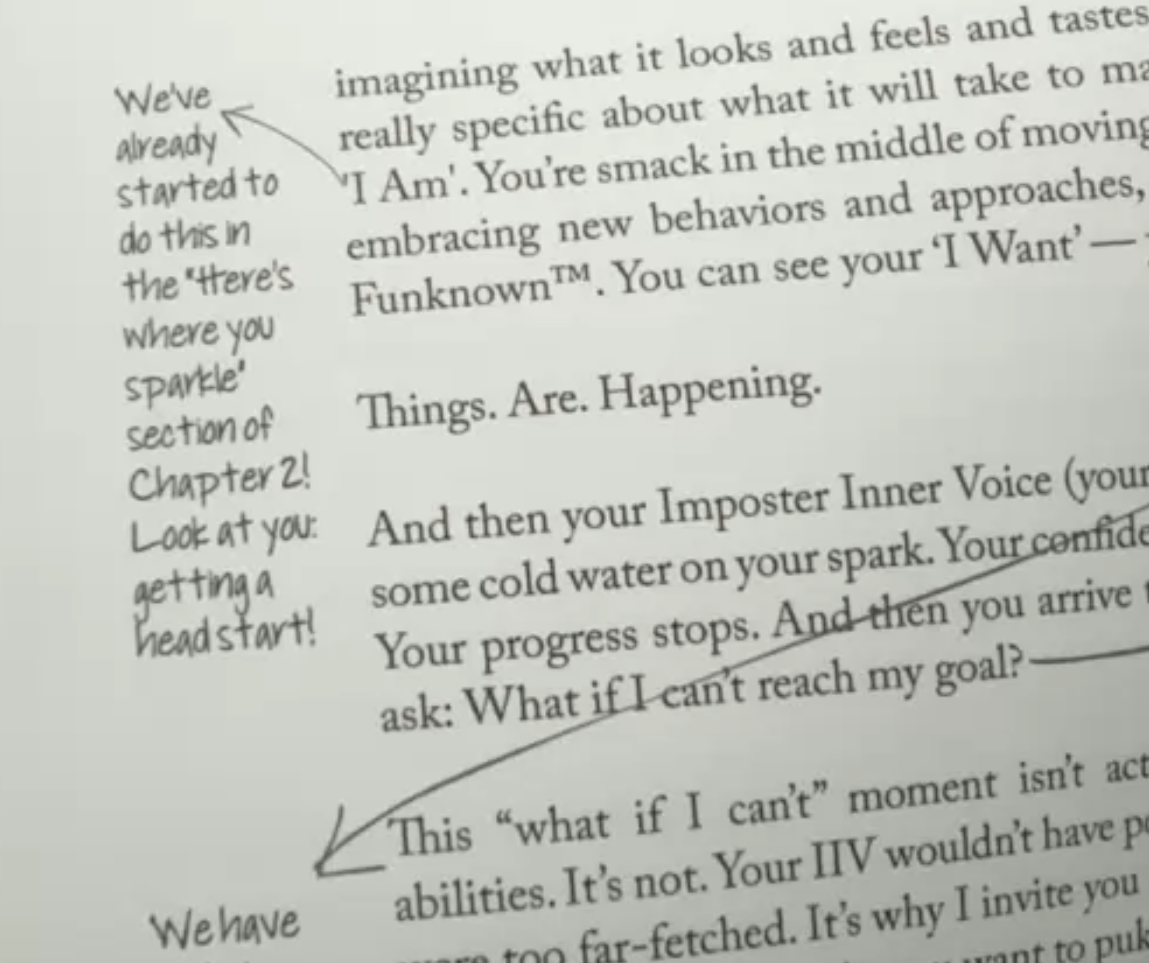
I’m also there with you: let me show you. If you get the paperback rather than the ebook, one of the things that really sets the physical reading experience apart from other books, you don’t have to “click” on the number to get to the footnote, as it’s right there in the marginalia. These notes are in my handwriting:
Rey: Wow, I love that this is your handwriting. So cool!
Kari: We’ve all done these things where we promise, I’m gonna read this book. I’m gonna do this digital program. And then, you stop reading the book halfway through, or you stop doing the program, because life gets in the way, or you let yourself talk yourself out of doing the thing.
And so even though I wrote the guts of the book as well, I wanted to remind people that I’m still there with them, like riding shotgun with them through the marginalia.
Maybe it’s also an opportunity for them to feel like they can also write in the margins and outside the margins as well. We’re all coloring outside the lines.
I want to recognize that I am a white lady. I have an invisible disability—I’m deaf in one ear. I wear hearing aids. I recognize I speak from this sort of norm-core experience, and I don’t ever want to make assumptions about or speak on behalf of queer people, trans people, and people of color.
But what I’ve heard from my clients and other readers is that they found themselves reflected in this text as well. That means a lot to me, because I have always wanted to provide a safe space for everybody to be exactly who they are.
Rey: I love that. And as a trans person reading your book, I felt like you were being very inclusive. I’ve read a lot of business materials from women who focus on supporting women. And then there’s the whole business book industry that’s like for white males.
Kari: Yeah, I have a whole bookshelf - *gestures to the other side of the room*
Rey: I thought your book did an exceptional job of both speaking to some of the things that women and gender diverse people experience, especially in the workplace, while being inclusive to the fact that men are reading your book, trans people are reading your book, queer people are reading your book, and you speak to them as well. I really felt that came through.
You posted a poll on LinkedIn asking what people are struggling with recently:
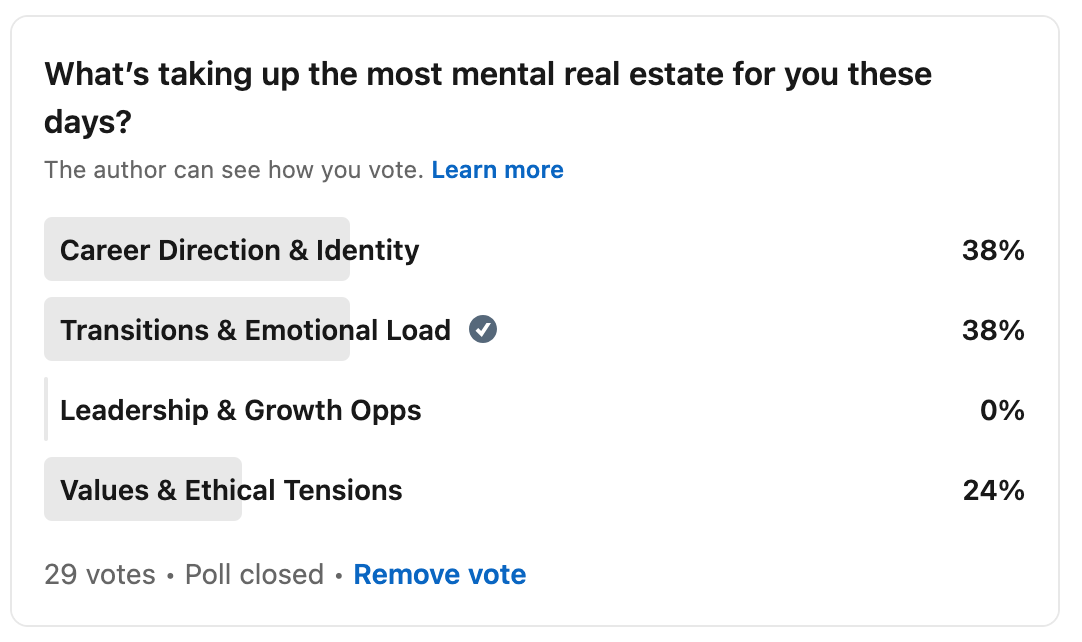
One of the options stood out to me: “transitions and emotional load.” I was like, hmm, what is that, and you had a definition:
Transitions & Emotional Load
Relationships shifting, health stuff coming up, family needs, political dumpster fires—you’re carrying a full damn backpack while trying to climb the mountain. You want space to breathe, process, and still make bold moves without feeling like you’re constantly drowning.
You use the word transition. I don’t think you meant gender transition, but it felt really relevant to trans people.
People during a gender transition often face shifting relationships and health issues. And political dumpster fires!
I was wondering if you had any advice specifically for trans people.
Kari: This is such a big question, and it’s such a gift of an invitation to answer.
This year has gotten progressively scarier every single day. And it’s a lot to just try to make it through each day with integrity and to try to find joy.
And so, to anyone who is in transition, to anyone who has recently begun that process, for anyone who has been living as who they are for any duration of time—I can’t imagine how scary this is right now, in addition to just being on this journey.
But you don’t have to carry that backpack by yourself.
If your relationships aren’t serving you—I mean, don’t push them off a mountain, but maybe step back. And that is really, really easier said than done. I have done this. When I was ill, in 2012, I was not healing holistically. I realized there were relationships that really weren’t serving me, and I had to let them go.
I was estranged from my dad for 10 years before he passed. Because I realized that even though that is a very specific type of relationship, I let him go.
It’s their fucking loss that they’re not here to see you sparkle.
If it gets too heavy, put whatever it is down for a little bit. Put it down because it doesn’t have to be yours to carry by yourself.
I think it was Nora Ephron, essay writer and screenwriter, who talked about all the things we juggle every day. Some of the balls we juggle are rubber, and if we drop one of the rubber balls, it’s okay, because it bounces. Sometimes it bounces away from us, and finds somebody else to pick it up. Maybe eventually it will bounce back to us.
And then there’s glass balls that we juggle, and you have to keep those afloat. These are your health, your well-being, and relationships you find value in investing in because they make you your best self and you make that person their best self. There’s reciprocity there.
We know that if we drop them that they will shatter, so the glass balls always have to stay aloft. And we have to make room for them with the rubber balls.
And then the third ball—the third thing we juggle—are bubbles.
Bubbles require a really light touch, they’re shiny and iridescent, things that I love, but they pop. Sometimes that means they weren’t yours to juggle to begin with. They’re the shiny things we haven’t quite figured out where they fit in but we’re very attracted to.
We have to make room for all three of these types of things. I think about transitions in general as finding room for the rubber, the glass, and the bubbles. And knowing when it’s okay to let something bounce away.
Knowing when it’s okay to let that glass ball shatter because it was cracked and cutting your hands every time you engaged with it. Knowing when it’s okay to let the bubbles float off for someone else to observe.
Maybe sometimes when juggling there’s a chainsaw, but that’s not a Nora Ephron thing, that’s a me thing. :)
Rey: This is such a beautiful answer with so much empathy. I really appreciate this.
Kari: Thank you.
Rey: Is there anything else you would like to share?
Kari: The title of my book, Hey Glitterbomb! A No-BS Guide to Being Too Much, Taking Up Space, and Loving The Legacy You Create, feels very big. I talk about this in my book a little bit, but I want to reiterate it here.
Sometimes people, communities, and workplaces don’t actually deserve all of us. They don’t deserve our personal umami-ness or our brand of too-much-ness. They don’t deserve it.
If we’re trying to be all of ourselves, and it’s really not working, I don’t want them to hide who they are. But I think there is a beauty that can come from the surrender of saying they just don’t deserve me.
Cause then you’re not losing energy to that. It can just be a fact, and then you can keep on going. Don’t worry about investing there anymore. We can put the focus back on ourselves and find some other place that does deserve all of us.
Life is life-ing really, really hard right now. And we’re getting into the holiday season, approaching a very hectic time of year, where there’s a lot of draw on our attention and big expectations: It’s got to be perfect. I need the perfect gift. I have to do this or that. There’s all these people I have to show up for.
Your best is more than good enough.
Your best is more than good enough, and if you have to say no, say no. Find a boundary, don’t find the hustle. If you bump into some things and you make a mistake, that’s okay, too.
But your best is really, really, much more than enough right now. Because we all have to survive this.
Rey: Thank you so much, Kari. This is so incredible and meaningful. I really appreciate you sharing your expertise and perhaps a little bit of coaching.

You can purchase Kari's book Hey Glitterbomb! here with a special discount just for Amplify Respect readers.

If you're interested in Kari's coaching, check out:


Please let us know what you think in the comments!
Amplify Respect is a newsletter to uplift and inform trans folks and allies.
If you find it helpful to learn how to talk about a trans family member, how to promote your work as an LGBTQ+ creator, or how to write about trans people respectfully, you should subscribe.